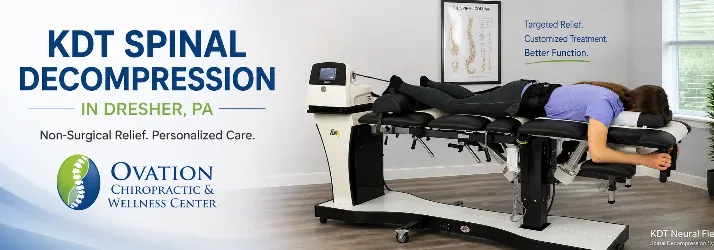
KDT Neural Flex Spinal Decompression in Dresher PA
When you're dealing with persistent lower back pain, neck pain, sciatica, or symptoms related to a spinal disc problem, finding the right treatment often starts with understanding why you're hurting in the first place.
At Ovation Chiropractic & Wellness Center, Dr. Ron Siscoe uses KDT Neural Flex spinal decompression in Dresher PA as one of the conservative treatment options available for appropriate patients with certain spinal conditions.
KDT spinal decompression uses controlled mechanical traction to gently unload targeted areas of the spine. But the technology is only part of our approach.
With more than 20 years in practice, Dr. Ron Siscoe, D.C. believes treatment should be based on the individual patient—not simply the name of a condition or an image on an MRI.
That's why spinal decompression at Ovation begins with an evaluation to determine what's contributing to your symptoms, whether decompression is appropriate, and how treatment should be customized for you.
What Is KDT Spinal Decompression?
KDT spinal decompression is a form of controlled mechanical traction used to gently distract targeted areas of the spine.
At Ovation Chiropractic & Wellness Center, we use the KDT Neural Flex system, which provides Dr. Siscoe with multiple treatment and positioning options for the cervical and lumbar spine.
Why does that matter?
Because two people can have similar complaints—such as lower back pain or sciatica—but respond very differently to certain movements and positions.
Rather than assuming every patient needs the same decompression protocol, Dr. Siscoe can adjust treatment according to your examination findings, symptoms, comfort and response to care.
Why Dr. Siscoe Uses KDT Neural Flex
Dr. Siscoe has spent more than two decades helping patients with musculoskeletal problems. His approach at Ovation Chiropractic & Wellness Center is multi-faceted and individualized.
The KDT Neural Flex system fits that philosophy because it gives him additional options when developing a conservative treatment plan for certain neck, back and disc-related problems. KDT Neural Flex allows treatment variables to be modified according to the patient and area being treated. That can include factors such as:
- The area of the spine being treated
- Patient positioning
- Amount of traction force
- Treatment cycles
- Positions that improve or aggravate symptoms
- Patient comfort and tolerance
- Findings from the examination
- Changes in symptoms as treatment progresses
The goal isn't to use a machine simply because someone has back pain.
The goal is to determine whether decompression is appropriate and, when it is, use it in a way that makes sense for that individual patient.
How Does KDT Spinal Decompression Work?
During spinal decompression therapy, you are comfortably positioned on the KDT Neural Flex table. The system then applies controlled distraction forces according to the treatment parameters selected by Dr. Siscoe.
Treatment typically involves alternating phases of traction and relaxation.
Depending upon your condition, this controlled traction is intended to reduce mechanical loading on targeted spinal structures and may be used as part of a conservative treatment program designed to improve symptoms and function.
One misconception about decompression is that more force automatically produces a better treatment.
That's not our approach.
Force, positioning and other treatment variables need to be appropriate for the patient. Dr. Siscoe considers your condition, size, sensitivity, examination findings and response when determining how decompression should be performed.
What Does Spinal Decompression Feel Like?
Patients generally feel a controlled pulling or stretching sensation as traction is applied.
Treatment is not supposed to be a test of how much force you can tolerate.
Dr. Siscoe wants feedback about what you are experiencing throughout care. If a particular position or treatment parameter isn't appropriate, the treatment can be modified.
Your response provides useful clinical information that can help guide future sessions.
Conditions Dr. Siscoe May Evaluate for Spinal Decompression
KDT spinal decompression may be considered for selected patients experiencing symptoms associated with certain spinal and disc-related conditions. These can include:
- Lower back pain
- Neck pain
- Sciatica
- Radiating leg pain
- Certain forms of radiating arm pain
- Bulging discs
- Herniated discs
- Disc-related pain
- Degenerative changes involving the spine
- Restricted spinal mobility
It's important to understand that appearing on this list doesn't automatically make someone a candidate for decompression.
Back and neck symptoms can have many different causes. Dr. Siscoe evaluates each patient before determining whether KDT decompression belongs in the treatment plan.
KDT Spinal Decompression for Herniated and Bulging Discs
Disc problems are one of the most common reasons people investigate spinal decompression.
The discs between your vertebrae help absorb and distribute forces throughout the spine. Changes to a disc can sometimes be associated with localized pain or irritation of nearby neurological structures, producing symptoms that travel into an arm or leg.
Mechanical decompression uses controlled traction to alter the mechanical loading placed on the targeted spinal region.
However, a disc bulge or herniation seen on an MRI doesn't tell the entire story.
Dr. Siscoe considers your symptoms and physical examination alongside relevant imaging when available. The objective is to understand whether the imaging findings actually correlate with what you're experiencing.
That distinction matters when deciding whether decompression is appropriate.
Can Spinal Decompression Help Sciatica?
Sciatica generally refers to symptoms involving the sciatic nerve pathway, often producing pain, numbness, tingling or other sensations extending from the lower back or buttock into the leg.
But "sciatica" isn't one single problem with one single solution.
Different conditions can produce similar leg symptoms.
Before recommending KDT decompression for sciatica, Dr. Siscoe evaluates your symptoms and examination findings to better understand what may be contributing to the nerve irritation.
If the findings indicate that mechanical decompression is appropriate, it may become one component of your conservative treatment plan.
Why Patient Positioning Matters
One of the features Dr. Siscoe values about KDT Neural Flex is the flexibility it provides in positioning a patient during treatment.
Patients with spinal problems don't always respond to movement in the same way.
You may notice, for example, that certain positions consistently reduce your symptoms while another position makes them worse. These responses can provide useful information during your evaluation and treatment.
The Neural Flex system gives Dr. Siscoe the ability to incorporate different positioning strategies rather than assuming that one standard decompression position is appropriate for every patient.
It's another way we can make treatment fit the patient instead of making the patient fit a predetermined protocol.
Spinal Decompression Is a Tool—Not the Entire Treatment Plan
At Ovation Chiropractic & Wellness Center, we don't believe good care begins and ends with lying on a decompression table.
KDT Neural Flex is a clinical tool that Dr. Siscoe can incorporate into a broader treatment strategy when appropriate.
Depending upon what your evaluation reveals, your plan may also involve chiropractic care, mobility work, rehabilitation, exercise recommendations, or other conservative therapies available at Ovation.
The combination depends upon the individual.
Our focus is on helping improve function and addressing factors that may be contributing to the problem rather than simply putting every patient through an identical series of treatments.
What Happens at Your First Visit in Dresher PA?
Your first visit begins with an evaluation. Dr. Siscoe will want to understand:
- Where you're experiencing pain or other symptoms
- How and when the problem began
- Whether symptoms travel into an arm or leg
- Which movements or positions make symptoms better or worse
- Previous treatments you've tried
- Previous injuries or surgeries
- Relevant medical conditions
- How the problem affects your work, sleep, exercise and daily activities
A physical examination helps Dr. Siscoe determine whether your symptoms appear appropriate for conservative care and whether spinal decompression should be considered.
Existing X-rays, MRI studies or other medical information may also be reviewed when relevant.
If decompression isn't appropriate for your condition, we'll discuss other options and, when necessary, referral for additional evaluation.
A Chiropractor's Perspective: Why the Evaluation Matters
After more than 20 years in practice, Dr. Siscoe has learned that patients who appear similar on paper aren't necessarily the same clinically.
Two people can both have "lower back pain."
One may have pain primarily in the back. Another may have symptoms traveling to the foot. One may feel considerably better standing, while another feels better sitting. Their histories, examination findings and imaging may also be completely different.
That's why Dr. Siscoe doesn't recommend KDT spinal decompression based solely on a diagnosis or symptom.
He looks at the complete clinical picture.
The KDT technology gives us options. The examination helps us decide which options make sense.
Is KDT Spinal Decompression Right for Everyone?
No.
There are circumstances in which mechanical spinal decompression may not be appropriate.
Your medical history matters, including previous spinal surgery, fractures, certain forms of spinal instability, pregnancy, osteoporosis and other health considerations.
That's another reason an evaluation is performed before beginning treatment.
Be sure to tell Dr. Siscoe about your complete medical history, previous surgeries, current diagnoses and any imaging studies you have had.
How Many KDT Decompression Sessions Will I Need?
There isn't one correct number for every patient.
Your recommendations will depend on factors such as:
- The condition being treated
- How long symptoms have been present
- Severity of your symptoms
- Examination findings
- Overall health
- Response to treatment
- Functional goals
Just as importantly, your progress should be reassessed.
Dr. Siscoe evaluates how you are responding so treatment decisions can be based on your progress rather than simply following the same predetermined schedule for everyone.
Frequently Asked Questions About KDT Spinal Decompression
Is KDT spinal decompression the same as chiropractic adjustment?
No. Mechanical spinal decompression and chiropractic adjustments are different procedures.
Depending upon your examination findings and treatment goals, Dr. Siscoe may recommend decompression, chiropractic care, rehabilitation or a combination of conservative approaches.
Can KDT decompression treat a herniated disc?
Spinal decompression may be considered as part of conservative care for certain patients experiencing symptoms associated with disc problems. Whether it is appropriate depends upon your symptoms, health history, examination findings and other clinical factors.
Can KDT decompression help sciatica?
It may be considered for certain patients with sciatic-type symptoms, depending upon the underlying cause and examination findings. Because different conditions can produce similar symptoms, Dr. Siscoe evaluates the patient before recommending decompression.
Do I need an MRI before spinal decompression?
Not necessarily. The need for diagnostic imaging depends upon your history, symptoms, examination findings and individual circumstances. If you already have relevant imaging, bring it with you or let our office know.
Is spinal decompression painful?
Treatment is intended to be controlled and tolerable. Patients commonly notice a stretching or pulling sensation. Your response is monitored so treatment can be modified when appropriate.
Is spinal decompression surgery?
No. KDT spinal decompression uses externally applied mechanical traction and does not involve surgery.
Is KDT decompression appropriate if I've already tried chiropractic treatment?
Possibly. Dr. Siscoe will want to know what treatments you've previously received, how you responded and what symptoms you're currently experiencing. Previous treatment doesn't automatically determine whether you are or aren't a candidate.
Will spinal decompression permanently fix a disc problem?
No responsible healthcare provider can guarantee that a particular treatment will permanently fix a spinal disc. Individual results vary. Our approach is to determine whether conservative care is appropriate, establish reasonable treatment goals and monitor how you respond.
KDT Spinal Decompression in Dresher PA
Ovation Chiropractic & Wellness Center provides KDT Neural Flex spinal decompression for appropriate patients in Dresher, PA and surrounding Montgomery County communities, including Fort Washington, Ambler, Oreland and the Upper Dublin area.
If back pain, neck pain, sciatica or a disc-related problem is interfering with your work, exercise, sleep or everyday life, the first step is determining what's contributing to your symptoms.
You don't have to decide for yourself whether you need an adjustment, decompression, rehabilitation or another form of care.
That's what the evaluation is for.
Schedule a Spinal Decompression Consultation
Contact Ovation Chiropractic & Wellness Center to schedule an evaluation with Ron Siscoe, D.C. and find out whether KDT Neural Flex spinal decompression may be an appropriate part of your care.
Ovation Chiropractic & Wellness Center
830 Twining Rd, Suite 7
Dresher, PA 19025
(215) 646-6400
Individual results vary. Spinal decompression is not appropriate for every patient or condition. Information on this page is provided for educational purposes and should not be considered a substitute for individualized healthcare advice, diagnosis or treatment.

OFFICE HOURS
Monday
9:00am - 1:00pm
3:00pm - 7:00pm
Tuesday
9:00am - 1:00pm
3:00pm - 7:00pm
Wednesday
9:00am - 1:00pm
3:00pm - 7:00pm
Thursday
9:00am - 1:00pm
3:00pm - 7:00pm
Friday
9:00am - 1:00pm
Saturday & Sunday
Closed
Ovation Chiropractic & Wellness Center
830 Twining Rd ste 7
Dresher, PA 19025